Agent-Led Growth: Why Your Next Subscriber Won't Be Human
Product-led growth redefined how SaaS companies acquire customers. Instead of gating everything behind a sales call, you let the product do the selling. It worked because it met buyers where they already were: online, researching, comparing, ready to act. Now the buyer is changing again. And this time, it might not be a person at all.
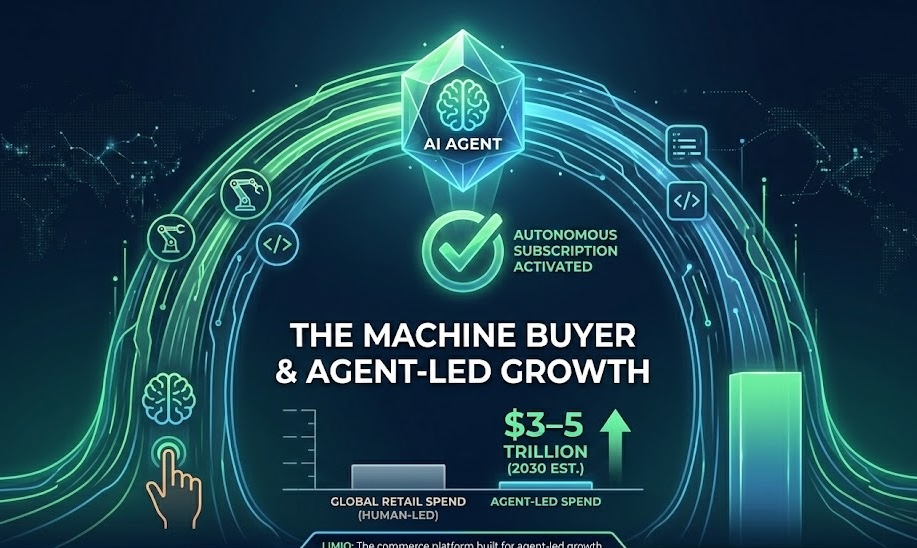
The rise of the machine buyer
AI agents are no longer a research paper or a chatbot bolted onto a help page. They are becoming autonomous economic actors. OpenAI's ChatGPT now lets users purchase products without leaving the conversation. Shopify launched Agentic Storefronts so merchants can sell through ChatGPT, Perplexity, and Microsoft Copilot. Mastercard is rolling out Agent Pay globally. McKinsey estimates agentic commerce could redirect $3–5 trillion in global retail spend by 2030.
This is not a B2C-only phenomenon. Two-thirds of B2B buyers already rely on AI agents as much as or more than traditional search when evaluating vendors. Amazon's CEO has framed AI-assisted purchasing as a preview of how all buying will work, including business procurement. The implication for subscription businesses is profound: a growing share of your future subscribers will be discovered, evaluated, and purchased by software, not people.
What agent-led growth actually means
We call this shift agent-led growth - a GTM motion where AI agents become a primary channel for both acquiring and serving customers. It works in two directions:
Agents that buy from you. An AI procurement agent working on behalf of a business browses your catalog, compares your offers against competitors, evaluates your pricing structure, and initiates a subscription - all without a human ever visiting your website. For this to work, your commerce infrastructure needs to be machine-readable: structured offer catalogs, API-first checkout, and real-time pricing data that an agent can parse and act on.
Agents that sell for you. On the other side, you deploy an AI agent on your own properties - your website, your support channels, your renewal flows - that guides human customers toward the right purchase. It understands your catalog, knows your current promotions, and can execute transactions. It is not a chatbot reading from a script. It is a commerce-aware agent with access to your full offer architecture.
Agent-led growth is not about replacing your sales team or your self-serve motion. It is about building a commerce layer that works for every type of buyer, human or machine, across every channel where transactions happen.
The infrastructure gap
Here's the problem: most subscription commerce stacks were built for a world where a human clicks through a pricing page, selects a plan, and enters a credit card. That workflow is invisible to an AI agent.
PDF pricing pages, "contact sales" buttons, and checkout flows buried behind authentication walls are dead ends for machine buyers. An agent cannot recommend what it cannot find, and it cannot buy what it cannot transact with programmatically.
The companies that win in agent-led growth will be those with commerce infrastructure that is API-first, catalog-driven, and machine-readable by default - while still delivering the rich, branded experiences that human buyers expect.
How Limio enables agent-led growth
This is exactly what we have been building at Limio. Our commerce platform is designed around a structured, API-accessible offer catalog - every product, price, promotion, and entitlement is available as data, not just pixels on a page.
With Limio's MCP server, AI agents can connect directly to your commerce environment - browsing your catalog, retrieving real-time pricing, and initiating purchases through the same infrastructure that powers your human-facing storefront. Our SDK and APIs mean that whether the buyer is a person on your website or an AI agent evaluating your product at 3am, the commerce experience is consistent, fast, and complete.
Behind the scenes, Limio's Order Orchestration Framework processes each transaction through a configurable plugin sequence - from payment to provisioning - so you can trigger entitlements in real time and give customers or their agents immediate access the moment an order completes. For new orders, renewals, upgrades, add-on purchases, credit packs and more.
And for the sell side, Limio gives you the tools to build intelligent agents into your own customer journeys - agents that understand your full offer catalog, surface the right promotion at the right moment, and close the transaction without a human in the loop.
The GTM motion no one is talking about
Product-led growth was the last decade's breakthrough. Agent-led growth is this decade's. The infrastructure decisions you make today - how your catalog is structured, whether your checkout is API-first, how your pricing data is exposed to the outside world - will determine whether AI agents can find you, evaluate you, and buy from you.
Your next subscriber might not be human. Make sure your commerce stack is ready for them.
Limio is the commerce platform built for agent-led growth. Learn more →
Your subscription business, on autopilot.
See how Limio can transform your commerce capabilities.