Creative Software: When PLG Meets Enterprise Sales Billing
Creative software companies keep telling us about the collision between their PLG motion and enterprise sales. The billing stack that handles self-service beautifully breaks when sales needs custom terms or partners want their own pricing. Hybrid go-to-market requires hybrid infrastructure.
The leadership meeting marked a turning point. For the first time in the company's fifteen-year history, the room was full of cross-functional leaders collaborating on go-to-market strategy. The new culture they were building required something their existing systems couldn't provide: unified commerce across self-service, sales-assisted, and partner channels.
Their billing stack had a different opinion. We hear this story constantly from creative software companies navigating the PLG-to-enterprise transition.
The Single-Motion Problem
This is the challenge facing creative software companies that grew up on a single motion - a pattern we see repeatedly in conversations with SaaS platforms such as 3D rendering tools, animation platforms, video platforms, and design software vendors. They started with individual artists buying online. They expanded from freelancers to studios. Now they serve both hobbyists trying the free tier and enterprises negotiating annual contracts.
McKinsey research suggests that the most successful SaaS companies aren't purely PLG or purely sales-led. They're developing a hybrid motion known as product-led sales. The product drives acquisition and qualification at scale. Sales resources deploy strategically for high-potential accounts and enterprise expansion.
The theory sounds elegant. The implementation breaks systems designed for one approach. And that's when these companies typically find us.
Where the Friction Shows Up
The friction points are consistent across creative software companies we talk to. Billing platforms handle self-service purchases efficiently - users sign up, select a plan, start using the product in minutes. But when sales needs to close an enterprise deal with custom terms, the process involves manual workarounds. When partners want to resell with their own pricing, the system requires parallel configuration that doesn't sync back to the core catalog.
One creative software company we're working with discovered these friction points during their billing implementation. Orders coming in created accounts, but the hierarchy between subscriber accounts and aggregated billing entities required manual intervention. Some salespeople had named accounts while the PLG motion continued driving individual signups within those same organizations. The collision between self-serve users and enterprise relationships created data conflicts nobody had anticipated. We see this exact pattern in nearly every creative software company navigating PLG-to-enterprise transition.
A 2024 Gartner survey found that nearly 60% of PLG initiatives fail to meet their initial objectives within the first 18 months due to implementation challenges. The pattern is consistent: companies adopt PLG expecting efficiency gains, then discover that their existing tools can't support the operational complexity of serving both self-service and enterprise customers through the same infrastructure.
When Front Office and Finance Collide
Their product catalog included subscription types that didn't fit standard billing models. Evergreen subscriptions for most customers. Term subscriptions with committed periods for enterprise contracts. Auto-renewal that enterprise customers expected. The flexibility that made their product successful created billing complexity that constrained their go-to-market options.
Industry analysis identifies the main hurdle: SaaS companies transitioning to hybrid models often don't have tools and systems to develop and maintain flexible pricing and packaging. Once front-office teams figure out PLG product catalogs, the problem shifts to finance attempting to recognize and report on new revenue models while maintaining compliance. The friction puts sales, product, and finance teams at odds.
The path forward required honesty about what the existing stack could and couldn't do. Their billing platform handled subscription management well. Their commerce layer was the gap. The checkout experiences, the sales-assisted quote-to-order flows, the partner portal that would enable reseller relationships—none of these existed in a form that worked across all three motions.
One Catalog, Three Channels
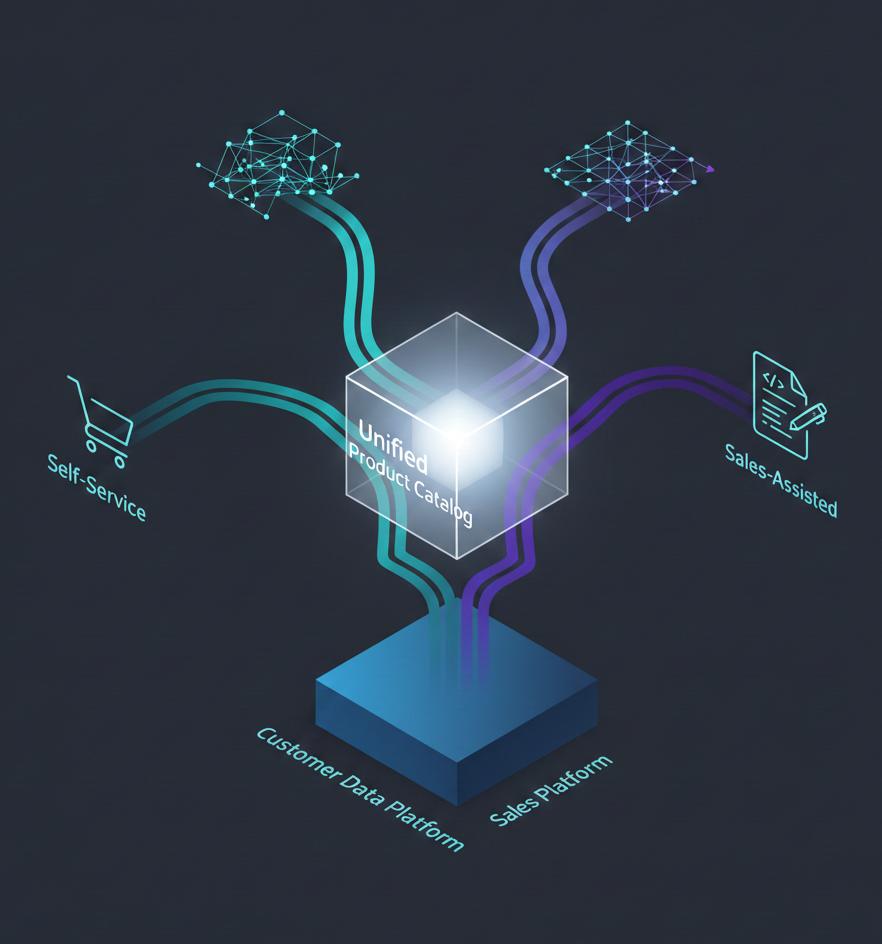
The solution wasn't replacing the billing platform. It was adding a commerce layer that could present the same product catalog through different channels. Self-service customers got a streamlined checkout with instant provisioning. Sales-assisted deals flowed through a quote process that generated checkout links rather than requiring manual order entry. Partners accessed a portal with their specific pricing and the ability to submit orders that created proper hierarchy in the billing system.
The webhook architecture that seemed like a niche requirement turned out to be essential. Creative software often requires integration with customer systems—license servers, enterprise authentication, deployment automation. The commerce layer needed to trigger these integrations reliably regardless of which channel originated the order.
For creative software companies navigating similar transitions, the question isn't whether to pursue hybrid go-to-market. Survey data shows 65% of SaaS buyers prefer both sales- and product-led experiences in the same buying decision. The question is whether your commerce infrastructure treats hybrid as a first-class architecture or as a series of workarounds bolted onto systems designed for a single motion.
Limio provides the commerce layer that sits between creative software products and their billing infrastructure, enabling PLG, sales-assisted, and partner channels to share a single product catalog while respecting the different checkout experiences each channel requires. The platform handles webhook integrations with native Zuora and Salesforce connectivity—without requiring custom development per channel.
Your subscription business, on autopilot.
See how Limio can transform your commerce capabilities.