If an AI Agent Tried to Buy Your Subscription Today, Could It?
There's a buyer you're probably not designing for. It doesn't visit your homepage, scroll your pricing page, or hover over the tooltip explaining the difference between Pro and Business. It reads. More and more, the first thing to touch your pricing isn't a person. It's an agent, ChatGPT, Claude, Gemini, or a purpose-built shopping assistant, sent to research options, compare plans, and sometimes buy, all on a customer's behalf. Everyone in SaaS is busy building agents that sell. That's worth doing. But almost no one is asking the simpler question first: when a buyer's agent shows up to look at your plans, can it actually find them, read them, and act? For most SaaS pricing pages today, the honest answer is no.
The buyer changed, again
Product-led growth worked because it met buyers where they were: online, researching, ready to act without a sales call. The buyer is moving again — and this time it might not be a person at all.
Agents now field the early questions. They compare plans, pull out prices, and hand the customer a shortlist before anyone opens a browser tab. And the buyers who arrive through an agent tend to be further along and readier to buy. Early reports from stores built for agent discovery point to materially higher conversion from AI-driven traffic than from traditional search.
The catch: an agent can only recommend what it can read.
Your pricing page is built for humans. Agents can't read it.
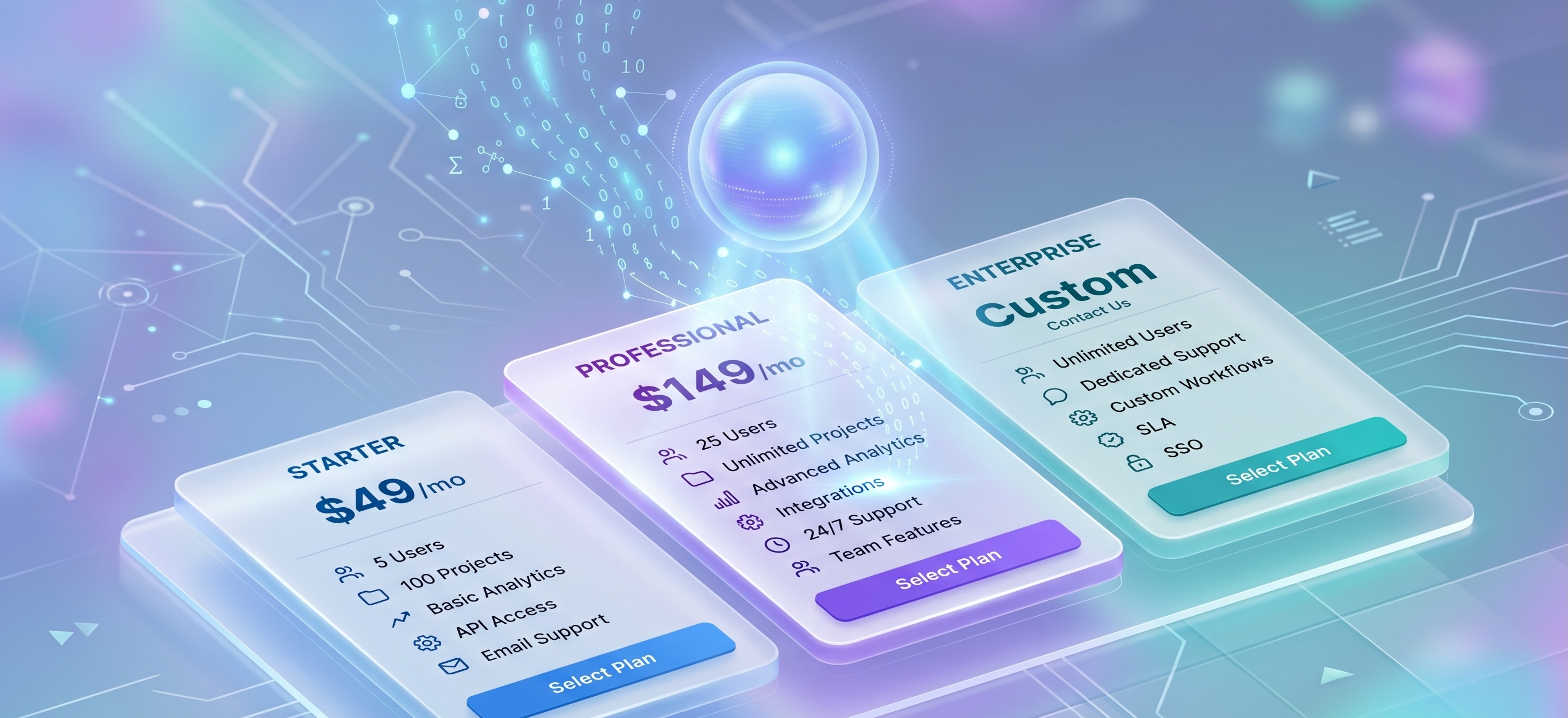
Most SaaS pricing pages are designed for the eye. The price sits inside an image. The plan comparison is a grid that only makes sense visually. The "what you get" lives in marketing copy, not in fields. Half the page renders with JavaScript an agent never runs.
A human handles all of that without thinking. An agent doesn't. When the data isn't labelled, the agent guesses — and it won't guess in your favour.
There's an even more basic trap. A lot of sites quietly block AI crawlers in their robots.txt without realising it, so the agent never gets through the front door. You can have the best plans on the market and still be invisible.
What "agent-readable" actually means
Making your product legible to an agent isn't a rebrand. It's plumbing.
It means putting the facts an agent needs into standard, machine-readable fields instead of burying them in prose or pictures. Price, plan name, what's included, billing terms — labelled explicitly, using a shared vocabulary like Schema.org, so any agent parses them the same way.
Think of it as a second front door. Your pricing page still works for people. A clean, structured version of the same information works for the agents reading on their behalf.
Subscriptions make this harder than retail
For a shop selling a single sweater, this is mostly solved: one price, one product, done.
Subscriptions aren't that. You've got tiers, add-ons, usage-based components, regional pricing, promotions, and renewal terms that shift depending on who's asking. A customer's agent doesn't just want a number — it wants to know which plan fits a team of 20 who need SSO and pay annually. That's a reasoning problem, and it only works if the underlying offer data is structured enough for the agent to reason over.
This is where most SaaS companies hit a wall. The pricing facts live across a billing system, a CRM, and a few hard-coded pages, and no single layer presents them cleanly. One company we work with recently mapped how many places their "current pricing" actually lived — the answer was five, and none of them agreed. No agent could make sense of that. Frankly, neither could their own team.
What to do this quarter
You don't need an agent strategy to start. You need your product to be readable. Three moves:
First, check you're not blocking the door. Look at your robots.txt and confirm AI crawlers can actually reach your pricing and product pages.
Second, get your price out of images and into fields. If a plan's price, name, and inclusions only exist as a picture or inside marketing copy, an agent can't use them. Mark them up as structured data — then check it actually parses. A good first pass: run your pricing page through Google's Rich Results Test and the Schema.org Validator. If those tools can't read your plans and prices back to you, an AI agent won't either. It's the fastest way to see your page the way a machine does.
Third, treat your commerce layer as the interface for agents, not just people. The part of your stack that handles selling — your pricing pages, checkout, and the offer data behind them — is what an agent reads and acts on. If your team can't change that layer without an engineering ticket, you can't keep it accurate as plans change. And accuracy is the whole game here.
The window is open now
Agentic commerce is early. The protocols are still settling, and plenty of buyers aren't ready to let an agent hit "buy" for them yet. That's exactly why this is worth doing now.
The SaaS companies that make their plans readable today get a head start when agents become how buyers shop tomorrow. The ones who wait will be the products the agents simply can't see.
It starts with one unglamorous question: if an agent tried to buy your subscription today, could it?
If you want your plans to be readable by both people and agents, come talk to us at Limio.
Your subscription business, on autopilot.
See how Limio can transform your commerce capabilities.