Your PLG Motion Has an Infrastructure Problem: It Needs a Commerce Layer
Most PLG initiatives don't fail because of bad entitlements logic or missing feature flags. They fail because there's no commerce experience converting users into paying subscribers.
Your PLG Motion Has an Infrastructure Problem: It Needs a Commerce Layer
Most PLG initiatives don’t fail because of weak entitlements logic or missing feature flags. They fail because there is no effective commerce experience converting users into paying subscribers.
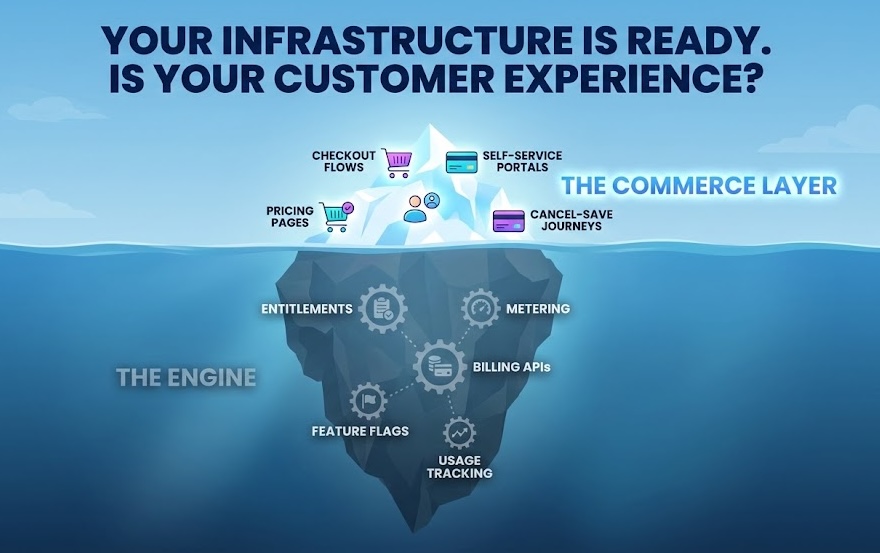
The market is full of tools that power the back-end of PLG: entitlements engines, feature-gating SDKs, usage-metering APIs, billing orchestration layers. These are critical components — but they are the engine, not the car.
You can have the most advanced entitlements system in place, and it still won’t drive revenue if customers cannot easily:
- Discover your plans
- Start a trial
- Upgrade on their own
- Be retained when they attempt to cancel
This is the gap. And it’s why many PLG motions stall after launch.
The Missing Piece: Subscriber Commerce
Consider the real buyer journey in a PLG model.
A user:
- Lands on your pricing page
- Selects a plan
- Enters payment details
- Manages their subscription
- Upgrades when needs grow
- Clicks cancel when value drops
Every one of these touchpoints is a commerce interaction.
Yet most PLG tooling ignores them.
- Entitlements platforms determine access.
- Billing platforms process invoices.
- But neither owns the experience layer — the place where conversion and retention actually happen.
That experience layer includes:
- Pricing pages
- Checkout flows
- Self-service subscriber portals
- Cancel-save journeys
This is the commerce layer — the front-end of your PLG motion.
Without it, engineering teams are forced to:
- Build custom checkout UIs
- Stitch together subscriber portals
- Hard-code cancellation flows
That isn’t PLG acceleration. It’s PLG technical debt.
PLG Is a GTM Strategy — Not an Engineering Project
A common pattern emerges when companies launch PLG:
- A six-month engineering initiative begins
- Custom pricing pages are built
- Checkout is hand-coded
- A subscriber portal is assembled via APIs
Then the iteration requests start:
- Marketing wants to launch a promotion
- Product wants to test a new plan tier
- Growth wants to A/B test pricing
Every change goes back into the engineering backlog.
But PLG is a go-to-market motion. The teams who understand buyer psychology, conversion optimization, and retention tactics — marketing and growth — should be able to launch and iterate without engineering tickets.
That requires:
- Visual editors for pricing pages
- Configurable checkout flows
- No-code tools for offers and promotions
GTM teams already control campaigns and content. They should have the same autonomy over PLG experiences.
PLG and Sales Are Not Separate Motions
The industry often frames PLG and sales-led growth as opposites. In reality, high-performing subscription businesses run both — seamlessly.
Examples:
- A self-service user hits a usage threshold and a rep closes an enterprise deal.
- Sales closes an initial contract, and the customer self-serves expansions later.
The problem is fragmentation.
- CPQ systems handle sales-assisted deals.
- PLG stacks manage self-service.
- Catalogs, subscriber records, and reporting are split.
- RevOps reconciles disconnected systems.
A proper commerce layer unifies both motions:
- One product catalog for both self-service and sales-assisted quotes
- One subscriber record, regardless of origin
- One unified revenue view for RevOps
This isn’t a luxury. It’s how hybrid growth scales without doubling operational complexity.
Retention Is Part of PLG — Not an Afterthought
Most PLG stacks focus heavily on acquisition and activation:
- Acquire users
- Gate features
- Meter usage
- Trigger upgrades
But what happens at cancellation?
If the process simply allows the user to cancel, revenue is lost unnecessarily.
Self-service includes the full subscriber lifecycle:
- Upgrades
- Downgrades
- Payment method updates
- Pause options
- Intelligent cancel-save flows
A commerce layer that stops at checkout is incomplete. Retention must be built into the experience — giving subscribers control while presenting the right offer at the right moment.
Billing-Agnostic by Design
Your commerce layer should not force a billing migration.
Whether you run on Stripe, Zuora, or a combination of systems, the experience layer should sit on top of your existing billing infrastructure — not replace it.
Enterprise subscription businesses have invested heavily in billing. The right approach complements that investment rather than competing with it.
The Bottom Line
PLG does not fail because infrastructure is missing. It fails because there is no commerce experience turning infrastructure into revenue.
If you’re assessing your PLG stack, ask:
Who owns the customer experience layer?
If the answer is “engineering, one ticket at a time,” then your PLG motion is missing a commerce layer.
Limio is the subscriber commerce platform that equips GTM teams to launch, convert, and retain through self-service — unified with sales-assisted workflows in Salesforce and built to work with your existing billing stack.
Your subscription business, on autopilot.
See how Limio can transform your commerce capabilities.