How Pilot made it possible to buy bookkeeping at 2 a.m. with Limio in four weeks
The checkout that closes itself
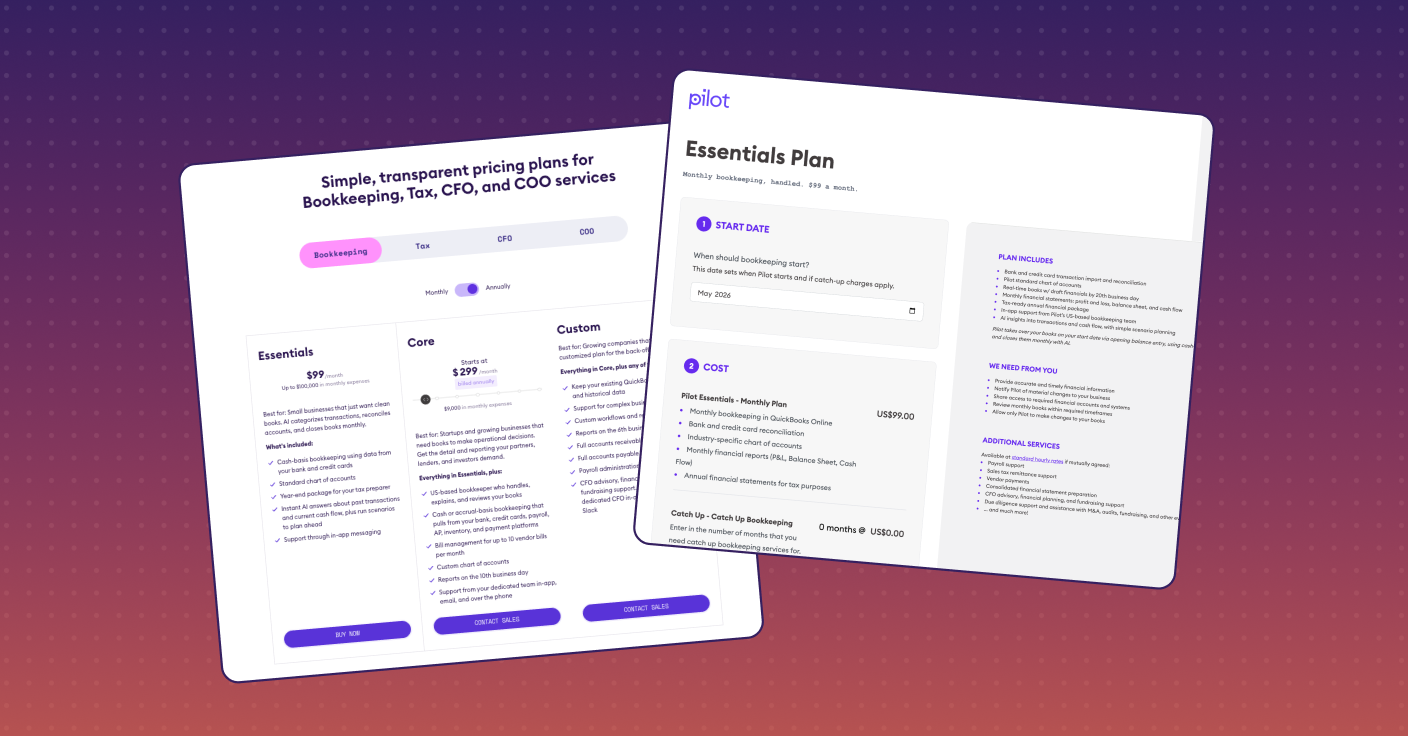
Pilot.com, a San Francisco startup that has raised over $150M from Sequoia, Index Ventures, Stripe, and Bezos Expeditions, handles the financial operations that growing businesses don't want to handle, like bookkeeping, tax, and CFO services, so founders can focus on building their company rather than closing their books.
Challenge
Every purchase at Pilot, however simple, required a sales rep. A rep collected the details, sent order forms, and manually created records across Pilot's billing and CRM systems. There was no way for a customer to buy on their own.
That worked at a certain size. But, at 3,500 customers and growing, the existing process created friction on both sides: prospects who'd already done their research waited longer than they needed to, and reps spent time on deals that didn't need them.
Pilot needed a self-serve channel fast, without rebuilding the infrastructure underneath. They had the back-end systems in place and had a pricing page as a starting point. However, Pilot lacked a system for self-serve - no checkout, no way to turn a completed purchase into the right records across their RevOps technology stack and their application layer automatically. Building that from scratch would have taken precious engineering resources and would likely have taken months. Pilot needed their self-serve checkout live in weeks.
Outcome
Limio connected to Pilot’s existing tech stack and spun up a complete, branded self-serve purchase flow for their Essentials offering - built and live in four weeks, with no changes to the billing or CRM infrastructure underneath.
A prospect now fills in a qualification form, gets routed to a Limio Checkout page, and buys. Limio creates the account, takes the payment, and pushes a closed-won opportunity into Pilot’s CRM - tagged as “self-serve sign-up” so attribution is clean from day one. No rep. No manual data entry.
With Limio Cart + Checkout, Pilot stopped gating low-ACV deals behind sales. Deals that used to need a rep now close themselves. The sales team’s attention shifts to the deals that move the number.
Early results
Pilot's self-serve checkout is live in production and already handling real customers. Customers can now come through entirely on their own, find the pricing page, and buy - an efficient motion resulting in a lower Customer Acquisition Cost (CAC).
When a prospect is ready to buy, they can. The prospect works on their own timeline, without waiting for a sales rep to manually generate and send an order form. Reps stay focused on the founders who want them in the room, educating them on why Pilot is the best solution for their needs.
This alone changed how the Sales team operates - fewer deals stuck in the pipeline and more revenue that closes itself. Reps also get visibility into abandoned self-serve carts, which flow back into the CRM system as leads to follow up on.
And because every order flows through the same automation chain - Limio to the billing system to the CRM system - the data is clean from the moment a customer buys. No manual record creation. No reconciliation. Operations teams have full visibility across every self-serve transaction.
“Some founders just want to sort out their books and get back to work. They've already done the research, they don't want a sales call. Limio allowed us to build that experience for those founders in just weeks.”— Lance Gonzalez, CRO, Pilot
“We wanted customers to be able to buy without going through a sales rep, and Limio was the fastest way to get that motion live alongside our existing setup. It’s already changing how the team operates and we now have the foundation to grow self-serve across our product line.”— Michael Medeiros, Sr. Revenue Operations Lead, Pilot
What's next
Pilot is already expanding the channel. New checkout flows are being scoped for their Booster program, which is a Bookkeeping and Tax offering for newly incorporated businesses. This will be the first time Pilot will put two SKUs into a single self-serve flow.
A financial self-service portal is in progress too, so existing customers can view their subscriptions, access invoices, manage payment methods, and resolve billing questions without contacting support.
The goal is an efficient self-serve motion that can cover the full customer lifecycle from acquisition, expansion, to retention - running continuously, with the commercial team in control and engineering out of the loop.
Your subscription business, on autopilot.
See how Limio can transform your commerce capabilities.