10 reasons your sports club should launch a paid membership
A paid sports membership gives fans year-round benefits for a recurring fee, creating predictable revenue and a direct, owned relationship with your fanbase.
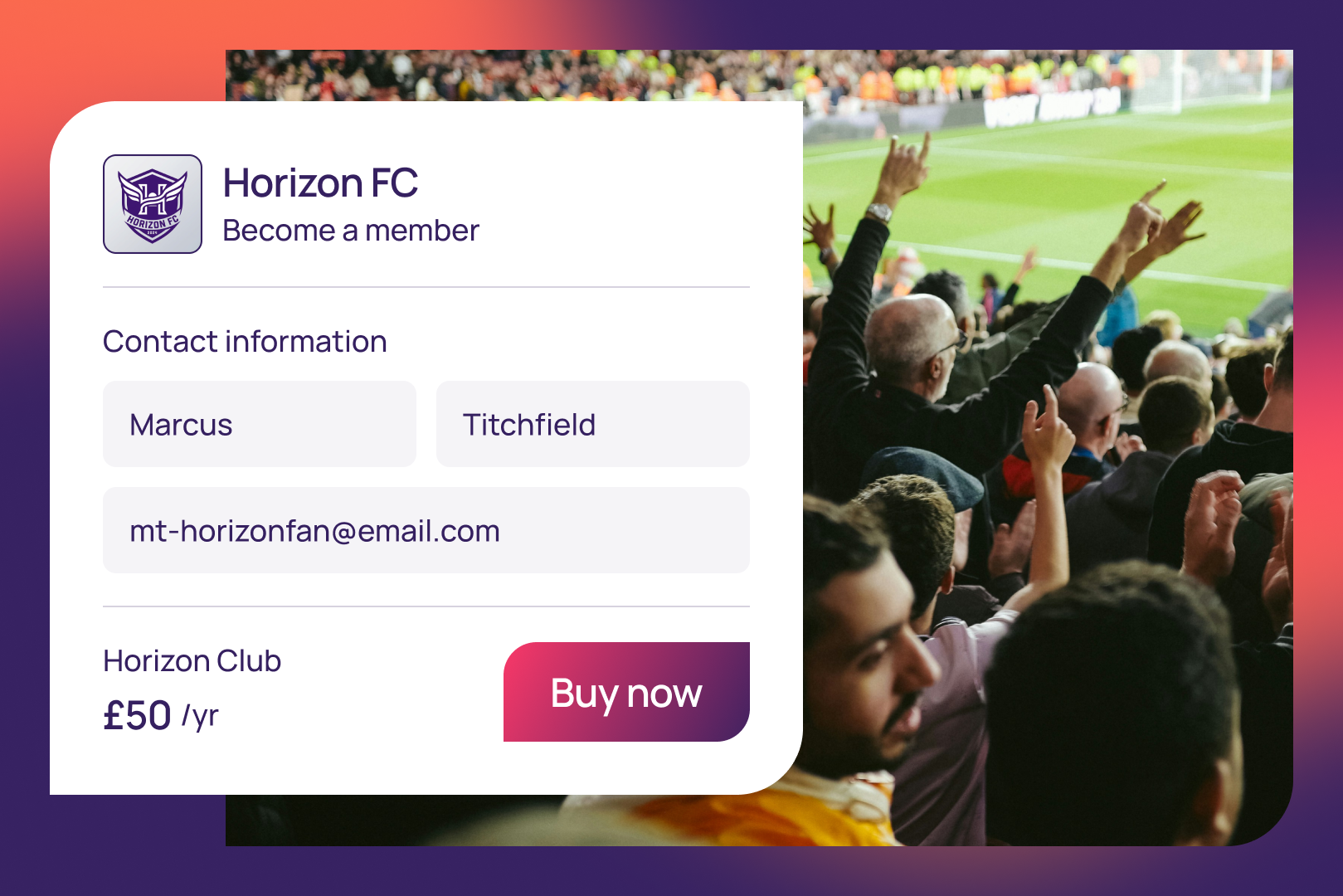
TL;DR A paid sports membership is a recurring subscription that gives fans year-round benefits, content and access for a set annual or monthly fee. For a club it does two things at once. It creates a direct, predictable revenue stream that keeps coming in whatever the results on the pitch, and it turns anonymous social followers into known fans you can contact, understand and sell to directly. Both matter more as broadcast and matchday income get harder to grow.
Ask most clubs where the money comes from and you get some mix of matchday, broadcast and commercial deals. All three matter, and all three are hard to grow on your own terms: gates have a ceiling, broadcast is negotiated over your head, and sponsors come and go. At the same time, the fans who would gladly give the club more, the ones following every result from another city or another country, often have no simple way to do it.
A paid membership is how a club bridges that gap. It gives committed fans a product they can buy, and gives the club a direct, recurring relationship it owns outright rather than one rented from a broadcaster or a social platform. The ten reasons below make the full case, and the questions at the end cover what clubs ask us before they start.
The ten reasons at a glance
You finally own the fan relationship
Predictable revenue that doesn't depend on results
It makes your digital investment pay for itself
You can reach and monetise a global fanbase
First-party data you can actually use
Members engage more, and spend more
It doesn't have to be a "ticketing tax"
You keep more of the members you win
It opens up new products to sell
One joined-up platform instead of a pile of tools
The ten reasons in full
Here is each one in detail, and what it takes to make it work.
1. You finally own the fan relationship
Your club may have millions of followers, but those audiences live on platforms you do not control. Relying on social reach alone means building on rented land: the algorithm decides who sees you, and you never really hold the relationship. A paid membership changes that. It turns a follow or a like into a named, contactable supporter whose details, preferences and history belong to you. That relationship is the foundation everything else here is built on.
2. Predictable revenue that doesn't depend on results
Matchday income rises and falls with form, weather and fixture luck. Broadcast deals are set years ahead and, for most clubs outside the top leagues, dominated by domestic rights. Membership is different. It is recurring by design, billed monthly or annually, and it keeps coming in through the off-season and a bad run of results. For a board watching the bottom line, a growing base of paying members is one of the few revenue lines a club can influence directly.
3. It makes your digital investment pay for itself
Clubs have poured money into apps, streaming and stadium connectivity, and most of it lands on the balance sheet as cost. Membership is the counterweight. Put that content and those experiences behind a paid tier and the platforms you already run start earning instead of only spending. Many clubs we speak to set an explicit goal: membership income should at least cover the running costs of their digital estate. That is a target a finance director can get behind.
4. You can reach and monetise a global fanbase
More than half of the leagues and teams surveyed by Opta say growing their international audience is a priority. The trouble is that overseas fans often have nothing to do with the club between matches. They cannot get to the stadium, and a season ticket means nothing to them. Membership gives that audience a reason to engage every week, and a way to spend with the club wherever they live, through a self-serve join and renewal that works in any timezone. For clubs whose league lacks global broadcast distribution, it can be the main commercial bridge to fans abroad.
5. First-party data you can actually use
Sponsors no longer just want a logo on a shirt. They want proof of a real, engaged, measurable audience, and that increasingly means first-party data. BCG has noted that clubs and leagues investing in direct fan relationships and data-driven monetisation earn materially more than those that do not. A membership programme is the cleanest way to collect that data with consent, then use it to personalise offers, target campaigns and show partners exactly who they reach. FC Bayern's much-cited "golden fan record" pulled together data from more than 50 systems for precisely this reason.
6. Members engage more, and spend more
Engaged fans spend around six times more than casual ones, according to FT Strategies. A membership is how you move a casual follower toward that engaged end of the scale, and how you keep them there. Members buy more merchandise, more tickets and more hospitality, and because they can upgrade their tier or add extras themselves, the club captures that intent the moment a fan feels it rather than weeks later.
7. It doesn't have to be a "ticketing tax"
This is the objection every club raises, and rightly so. Fans react badly to any scheme that feels like paying twice for a seat they already have, and there are cautionary tales of models that made membership a condition of buying a ticket. The answer is to lead with value, not gatekeeping: exclusive content, ticket exchange for games you cannot attend, member-only experiences, partner rewards and early access rather than locked access. Done well, membership feels like a benefit fans choose, not a charge they resent.
8. You keep more of the members you win
Winning a member is only half the job. Most clubs lose a meaningful share of revenue every year to renewals that never happen and cancellations that go unchallenged. A good setup turns that around with smooth automatic renewals and a cancel-save flow that reminds a leaving member what they would give up, with the option of a targeted offer at the right moment. Retention is far cheaper than acquisition, and small gains in renewal rate compound quickly across a base of tens of thousands.
9. It opens up new products to sell
A membership is a platform, not a single product. Once it exists you can layer new things on top: gift memberships and fan packs at Christmas, ticket exchange between members, first access to concerts and non-football events at the stadium, money-can't-buy experiences, and a natural progression path for younger fans as they grow up. Each is a fresh revenue line that only works because the membership relationship is already there.
10. One joined-up platform instead of a pile of tools
Most clubs run ticketing, e-commerce, streaming and CRM on separate systems that do not talk to each other, often with a different login for each. That fragmentation is what makes membership feel daunting. The clubs that succeed put a single commerce platform built for subscriptions across the top, with billing running through tools they already use like Stripe, so a fan signs in once, buys and renews without friction, and shows up as one person across every system.
The takeaway
A paid membership is the one move that answers a board's revenue question and a fan's engagement question at the same time. The clubs getting it right treat it as a genuine product, lead with value over gatekeeping, and run it on something fans can manage themselves all year round. If that is the year you are planning for, it is worth seeing what a membership platform built for exactly this looks like in practice.
Frequently asked questions
Your subscription business, on autopilot.
See how Limio can transform your commerce capabilities.