Self-Service to Sales Handoff: Bridging It With AI
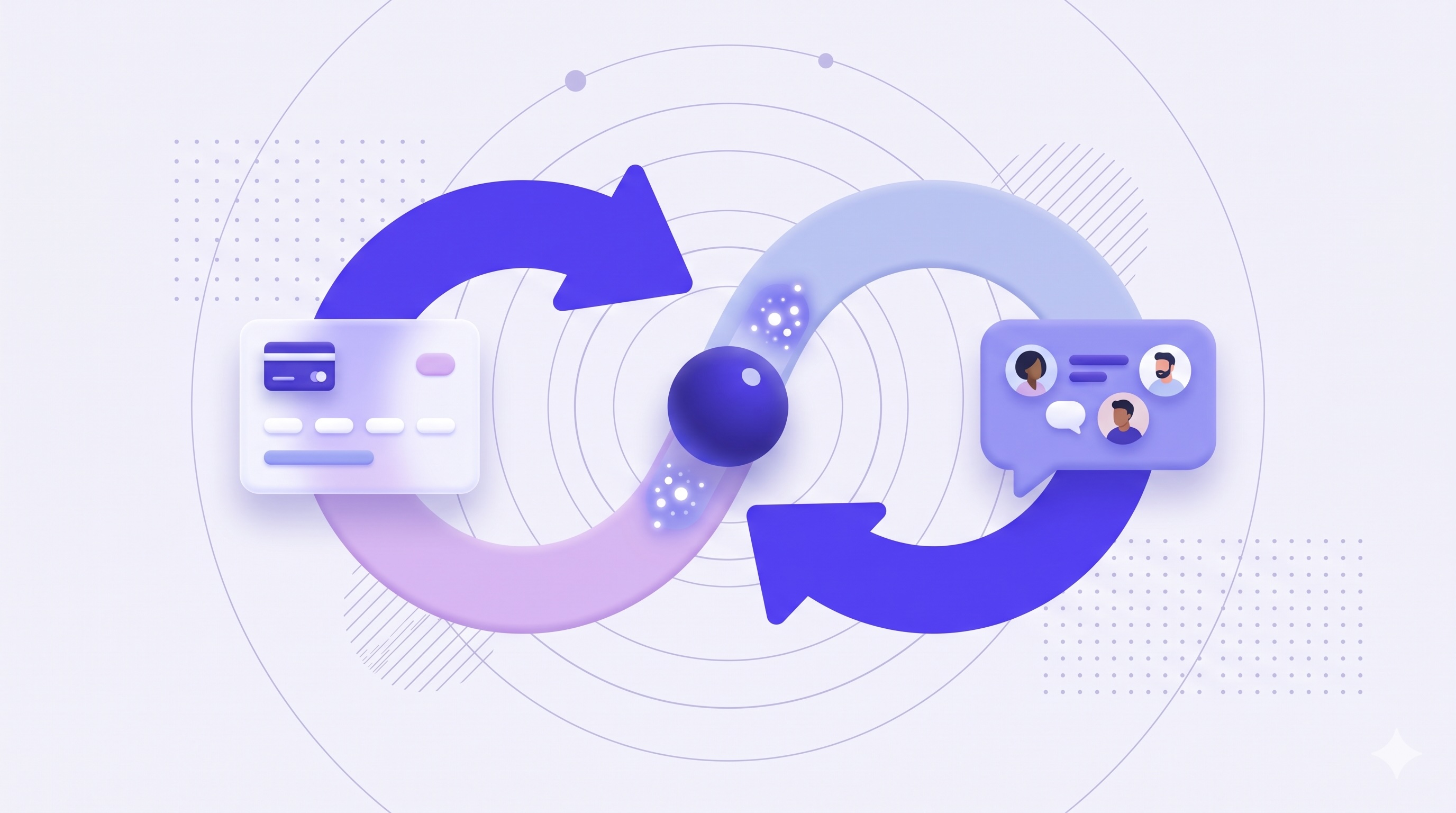
The self-service to sales handoff is the moment a self-serve customer outgrows self-serve, or a sales lead is simple enough to self-serve. Done badly, it is a cold transfer that loses context and momentum. Done well, with an AI agent in the middle, it is a smooth bridge where context carries across and nobody starts over.
Self-service is spreading fast in subscription and SaaS businesses, but the blocker is rarely desire. It is complexity. Complex catalogs and business models make pure self-serve hard, and that is exactly where the handoff matters.
The handoff goes both ways
Most teams think of handoff in one direction. In reality there are two, and an agent needs to handle both:
- Self-serve to sales. A self-serve customer hits a complexity threshold, say too many accounts or seats, a non-standard term, or a custom requirement, and needs a human.
- Sales to self-serve. A lower-value or straightforward deal does not need a rep at all and should be routed down to self-serve checkout, freeing sales for deals that need them.
An agent that only does one direction leaves half the value on the table.
Why the naive handoff fails
When self-serve hits a wall today, the customer usually gets dumped into a generic contact-sales form or a cold queue. They re-explain everything. The rep starts discovery from scratch. The momentum the customer built configuring their own purchase evaporates. There is a subtler failure too: some businesses turn self-serve off because customers complete purchases without understanding what they bought, then churn or open a support ticket. The problem there is not self-serve; it is the absence of explanation during the purchase.
How an AI agent makes the handoff clean
- Detects the threshold by recognizing when a self-serve journey has become too complex, or a sales lead simple enough to self-serve.
- Collects the context: what the customer is trying to do, what is blocking them, what they have already configured.
- Creates the opportunity by writing a structured opportunity or lead to the CRM so the handoff is warm.
- Hands off without a cold start, so inside sales picks up with the full story.
- Explains during, not after, so routed-down self-serve buyers get clarity on what they are buying at checkout.
The goal is a handoff that is cleaner, not just faster, with context preserved in whichever direction the customer moves.
Why an agent is uniquely suited to this
The handoff problem is really a context problem, and context lives in systems: the catalog, the CRM, billing, the customer's own session. An agent connected to those tools can read the threshold, package the context, and write the opportunity, work that a static contact-sales form cannot do. It can also simplify the experience of a complex catalog without forcing you to simplify the catalog itself. This is the same engine that powers proactive onboarding and that keeps your sales team out of low-value support and billing work.
FAQ
What is a self-service to sales handoff?
The transition when a self-serve customer needs human sales help, or a sales lead is simple enough to self-serve. An AI agent manages it by carrying context across the transition instead of forcing a cold restart.
Why do self-serve customers need to reach sales at all?
Complexity: multiple accounts or seats, non-standard terms, custom requirements. Beyond a threshold, a human adds value; below it, self-serve is faster for everyone.
Can an AI agent route deals down to self-serve too?
Yes. Straightforward, lower-value deals can be routed to self-serve checkout, freeing reps for deals that genuinely need them.
How does the agent prevent the bought-it-but-did-not-understand-it problem?
By explaining what the customer is purchasing during checkout, not after, reducing confusion, churn, and support tickets from self-serve buyers.
Bridge self-service and sales without cold transfers. Talk to a Limio agent.
Your subscription business, on autopilot.
See how Limio can transform your commerce capabilities.