Start with Stripe. Scale Your Commerce with Limio.
Stripe powers your billing foundation. Limio extends it with the commerce layer revenue teams need to scale pricing, packaging, and selling across every channel.

Stripe gets you to market. Limio helps you scale.
Stripe has become the billing foundation for many modern SaaS and subscription businesses. It is fast to launch with, flexible for developers, and reliable at scale. For many companies, Stripe Billing is where their monetisation journey begins.
For a significant part of that journey, it works exactly as intended. However growth rarely introduces a billing problem, more often it is likely to introduce a commercial one.
As companies scale, pricing becomes more nuanced. Bundles and regional variations are introduced. Sales-assisted deals begin to sit alongside self-serve flows. Partner channels become part of distribution. Experimentation increases as teams refine their positioning and packaging. Customers expect flexibility regardless of how they choose to buy.
Stripe remains the system of record for subscriptions and payments throughout this evolution. However, as commercial complexity grows, more of the logic that defines how offers are structured, packaged, governed, and distributed sits around billing rather than inside it.
This is the point at which many teams begin to look for a commerce layer.
When billing works, but commercial orchestration becomes harder
At scale, even strong PLG businesses encounter new operational requirements. Revenue teams need to experiment more quickly, introduce more variation into pricing, and ensure that every channel presents a consistent commercial experience.
In practice, this often means teams need to launch pricing experiments across customer segments, adjust packaging without creating inconsistencies between web and sales, keep website, sales, and partner offers aligned, introduce regional variations without duplicating logic, and support upgrades, renewals, and cross-sell paths in a more dynamic way.
None of this implies that Stripe is the wrong foundation, it provides a market leading billing experience. However, what changes is the need for a layer that manages how commercial logic evolves on top of billing.
Introducing Limio for Stripe
Limio for Stripe is built for this next stage of growth.
Stripe continues to handle subscriptions, invoicing, and payments. Limio adds a commercial orchestration layer above it, giving revenue teams direct control over how offers are defined and deployed across channels.
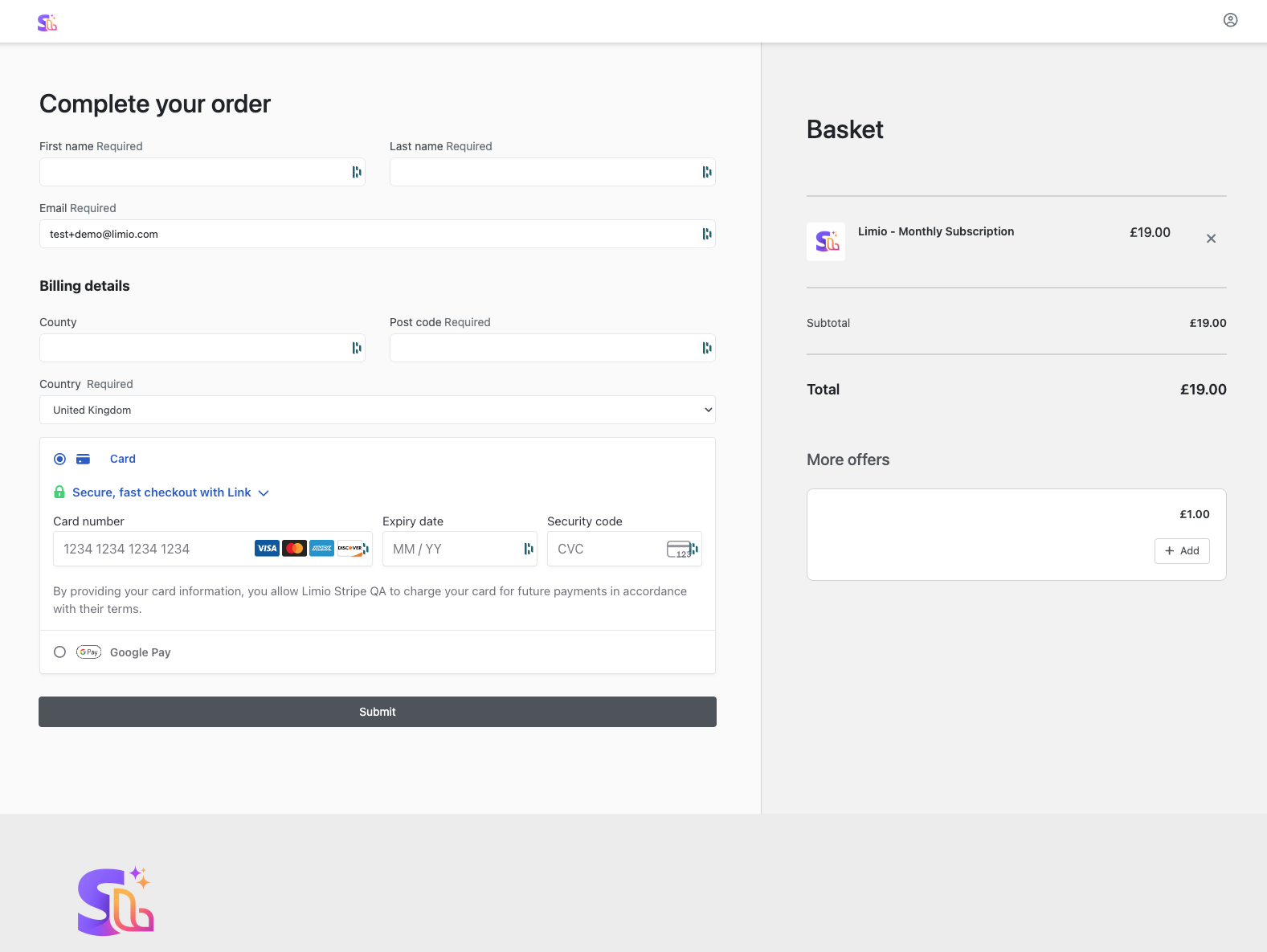
With Limio for Stripe, teams can manage pricing pages and checkout experiences, bundles, promotions, and packaging logic, self-service upgrades and renewals, sales-assisted (CPQ) quoting through Salesforce, and partner-led commerce through branded portals.
All transactions continue to flow back to Stripe Billing in real time. There is no migration and no replatforming required.
Stripe remains the billing foundation. Limio extends the commercial layer that sits above it.
Improving PLG as you scale
It is sometimes assumed that complexity only appears when companies introduce hybrid or sales-led motions. In reality, scaling PLG introduces its own demands.
As segmentation increases and experimentation accelerates, pricing becomes more dynamic and iteration speed becomes a competitive advantage. Revenue teams need to refine offers frequently, introduce promotional paths, and test packaging changes without relying on engineering cycles.
Limio enables teams to refine and extend self-serve flows without modifying their underlying billing setup. Pricing experiments, packaging changes, and promotional logic can be managed at the commerce layer, while Stripe continues to power subscriptions underneath.
The billing engine remains intact, and the commercial model becomes a lot more adaptable.
Expanding into hybrid and partner channels without fragmentation
Most high-velocity SaaS and AI businesses now operate across multiple selling motions simultaneously. Customers may discover a product online, speak to sales before purchasing, or transact through a partner. They expect continuity across each interaction.
Limio for Stripe unifies these motions through a shared commerce layer that includes a single catalog deployed across web, Salesforce, and partner portals, consistent pricing and packaging logic, one source of truth for offers, and real-time synchronisation with Stripe Billing.
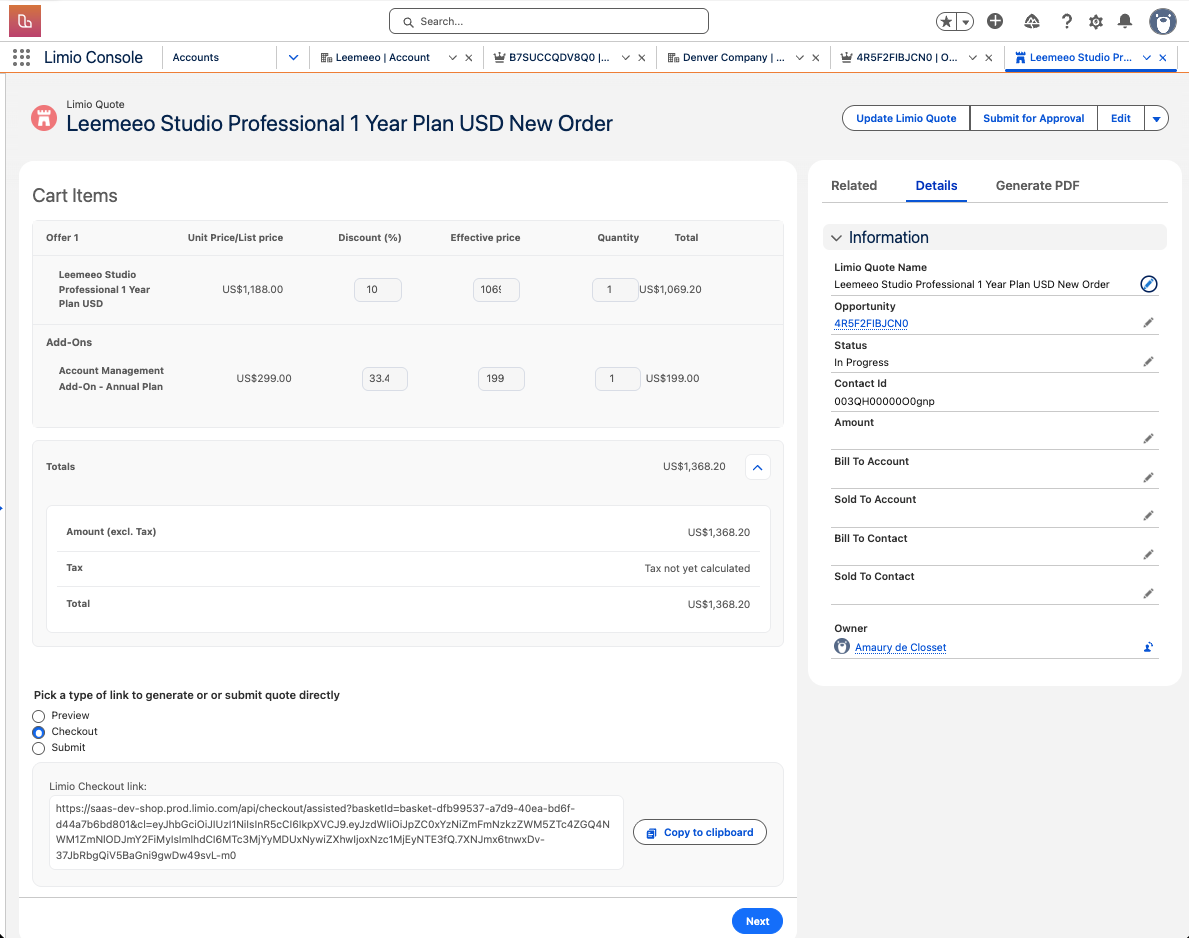
A quote can begin in Salesforce and complete online. A partner can provision on behalf of a customer with governed pricing. A self-serve user can upgrade instantly. Each transaction is still powered by Stripe.
And the channel landscape is still expanding
Beyond web, sales, and partner motions, a new class of channel is emerging. AI agents, operating through platforms like ChatGPT, Claude, and Gemini, are beginning to discover, evaluate, and purchase software on behalf of buyers. This is agent-led growth: a world where your next subscriber may not visit your pricing page at all, but instead transact through a conversational interface that your marketing team never designed.
Each of these AI platforms represents a distinct channel with its own interaction model, and together they make the commercial landscape more complex and more cross-channel than it has ever been.
For teams already managing the tension between self-serve, sales-assisted, and partner-led motions, agent-led commerce adds urgency to a challenge that was already growing. The businesses that scale through this shift will be those with an omnichannel commerce platform that has the infrastructure to work at the speed of both human buyers and the agents acting on their behalf.
When a commerce layer like Limio for Stripe makes sense
Limio for Stripe is a strong fit for teams that began with Stripe for self-serve and are now adding sales or partner motions, or for teams that want to increase pricing experimentation without depending on engineering cycles.
It is particularly relevant when web, sales, and partner channels need tighter alignment, when pricing changes feel slower than revenue growth, when operational headcount grows faster than commercial systems, and when RevOps teams want ownership of day-to-day offer changes.
Stripe remains a strong billing foundation. Limio extends it to support scalable hybrid and omnichannel growth.
Start with Stripe, scale with Limio.
Stripe helps you get to market quickly and reliably. Limio helps you scale how you sell, experiment, and expand across channels.
If you are growing on Stripe and beginning to feel the operational impact of scale, we would be glad to show you how Limio can help.
Learn more:
- JazzHR loves Limio agility and flexibility: read why.
- Watch this 85 second video on how Limio for Stripe can power your SaaS.
- Find Limio on the Stripe partner directory.
- Meet us at Stripe Sessions in San Francisco at our booth on April 29-30, 2026.
Your subscription business, on autopilot.
See how Limio can transform your commerce capabilities.